
OpenAI Build Week · Developer Tools

AI can generate network CLI. Llebre proves whether it should be released.

Llebre turns operator intent into a GPT-5.6 architectural report, a typed Network Digital Twin and vendor-aware CLI - then independently verifies every artifact in Rust/WASM before it can reach the terminal.

No installation. No device credentials. No automatic deployment.

Safe Campus · Huawei VRP Local first
Current artifact

Architecture ready for review

Verified
Operator intent Segment campus access into staff and guest VLANs, preserve management reachability and reject any unprotected Layer 2 cycle.
01GPT‑5.6Architecture + candidate
02Typed twinExact network model
03Rust/WASMTopology + CLI gates
04EvidenceBound to one fingerprint
CLI released for operator reviewAll current artifacts share the same intent fingerprint.
20versioned offline evaluation cases
5supported network vendor profiles
2independent Rust/WASM verification engines
0device credentials stored or commands executed

The hard problem is not generating commands. It is knowing when not to release them.

The product thesis

A Network IDE, not a chatbot with a terminal.

Network changes are stateful, vendor-specific and operationally risky. Llebre makes the model part of a visible engineering system instead of treating its answer as authority.

01 · REASON

Turn intent into architecture, not plausible prose.

GPT‑5.6 Sol receives bounded operator intent and a selected vendor profile, then returns strict structured output: an architectural report, a typed Digital Twin and a candidate configuration artifact.
02 · VERIFY

Challenge the model with code it cannot overrule.

A browser-native Rust/WASM simulator checks topology integrity, addressing, subnet overlap, Layer 2 cycles, VLAN continuity and static-route completeness. A separate command gate evaluates the candidate CLI.

03 · PROVE

Bind every decision to deterministic evidence.

Intent, vendor, revisions, findings, CLI and change evidence are tied to the same SHA‑256 fingerprint. Change the intent or vendor and every downstream artifact becomes stale atomically.

The trust boundary

AI handles ambiguity. Deterministic systems decide release.

A valid model response is not the same thing as verified CLI. Llebre preserves separate provenance for reasoning, topology simulation, command policy and the final review artifact.

01Operator intent

Treated as untrusted input and bounded before the request reaches the model.

02GPT‑5.6 Sol

Performs contextual architecture reasoning and vendor-aware candidate generation.

03Typed Digital Twin

Converts the proposal into a runtime-validated, inspectable network model.

04Rust/WASM gates

Simulate topology and independently reject unsafe or unsupported CLI.

05Review evidence

Release only when every artifact is current, consistent and verified.

Fail-closed by construction. Parse failures, unknown syntax, stale responses, vendor mismatches, unavailable WASM or any blocked command retain the candidate and withhold CLI.
One coherent product experience

Everything a judge needs to inspect is in the workspace.

The architecture, topology, candidate revision, deterministic findings, CLI gate and change evidence are visible surfaces - not hidden prompt machinery.

Actual product

A focused Network Engineering IDE

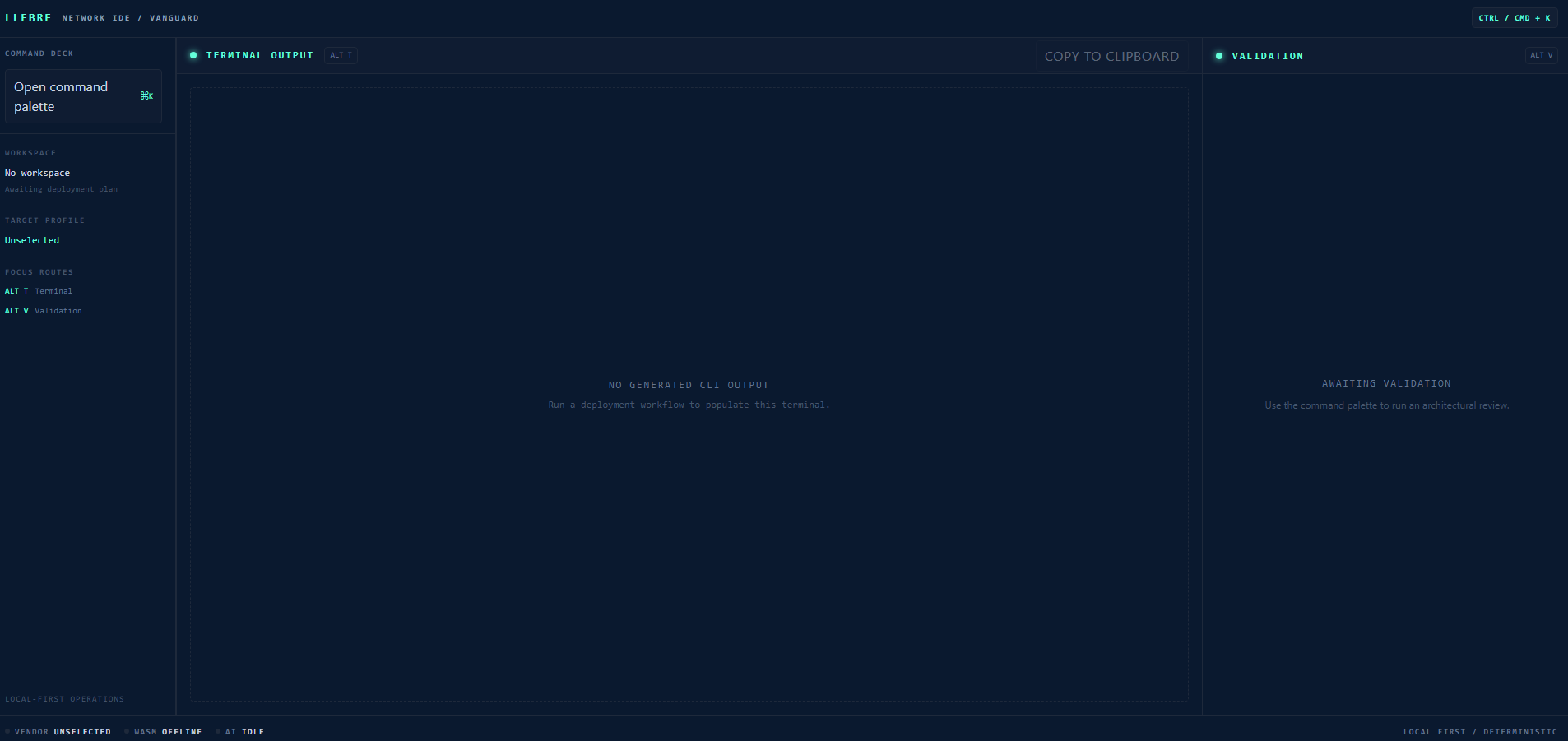
Click-first and keyboard-first navigation, local workspace state and an inspectable terminal release boundary.

Llebre Network IDE interface with workspace, terminal and validation surfaces
Versioned workspace

The network model is the source of truth.

Immutable accepted revisions, recoverable drafts, semantic patches and exact base fingerprints prevent prompt drift from silently rewriting history.

SHA‑256
Digital Twin

Topology that can be tested.

Entity-linked findings make every duplicate address, overlap, broken VLAN path or Layer 2 cycle inspectable.

Vendor-aware

Five profiles, explicit coverage.

Cisco IOSHuawei VRPD‑Link DGSMikroTik RouterOSHPE ArubaOS
Immutable evidence

A change package, not a confident answer.

Stable JSON and Markdown exports bind semantic delta, checks, risk, rollback posture and provenance into one review record.

Golden demo

Judge the real product in 90 seconds.

The fastest path exposes both sides of the project: GPT‑5.6 reasoning and an independent local safety boundary.

1
Launch Safe Campus demoOpen the preloaded Huawei VRP campus scenario without starting a billable request.
2
Select Validate & GenerateRun GPT‑5.6 Sol through the protected Responses API gateway.
3
Inspect ArchitectureSee the structured report and its assumptions instead of a hidden chat response.
4
Inspect Digital Twin & Trust EvidenceReview topology findings and separate engine provenance.
5
Open the Change planTrace ordered checks, semantic delta, risk and rollback posture.
6
Run Local Safety Self-TestWatch the browser-native gate block an unsafe CLI fixture without calling OpenAI.
Start the golden demo
Rust/WASM · isolated self-testNO OPENAI CALL
Ready. Run the local safety fixture.
Built for the Developer Tools track

A non-trivial implementation with a product-level experience.

Technological implementation

AI plus independent systems engineering.

Strict TypeScript, React, IndexedDB revisions, GPT‑5.6 Structured Outputs, Rust/WASM, native evaluation and a protected server-side gateway.

Design

A coherent workflow, not a proof-of-concept screen.

A guided entry, click and keyboard parity, visual topology, evidence surfaces, deterministic status and a live testable demo.

Potential impact

Reduce the trust gap in AI-assisted infrastructure.

Network engineers can use generative reasoning without silently accepting generated commands as operational truth.

Quality of the idea

The model proposes. The local engine disposes.

Llebre combines an AI architecture layer with typed network state and deterministic release gates in a browser-native Network IDE.

Built with Codex

Codex accelerated the system - not just the presentation.

The hackathon work established the canonical model contract, persistence and revision boundaries, topology workbench, Rust/WASM ABI, vendor compiler contracts, immutable change packages, evaluation harness and security foundations.

Canonical typed NetworkModel
Revision and candidate lifecycle
React Flow topology workbench
Rust/WASM validation core
Vendor semantic compilers
Fail-closed gateway contract
Evidence-grade offline evals
Threat model and test foundations
Model allocation
S
GPT-5.6 SolPrimary reasoning brain
T
GPT-5.6 TerraWASM and Rust execution arm
L
GPT-5.6 LunaFrontend and remaining delivery
OpenSource pledge

The trust layer should be inspectable by everyone.

When the hackathon ends and the remaining core capabilities are implemented, Llebre will be released as Open Source. Network engineers will be able to inspect the model, extend the vendor layer and audit the safety boundary together.

Planned after hackathon Source release follows core completion
01
Finish the core workflowComplete the remaining IDE, validation and evidence capabilities.
Build
02
Document the contractsPublish the model schema, compiler boundaries and safety decisions.
Explain
03
Open the repositoryRelease the project for review, contribution and vendor expansion.
Share
An honest release boundary

Llebre does not connect to devices. That is a safety decision.

The project produces reviewable architecture, candidate CLI and deterministic change evidence. It does not store credentials, execute configuration, claim rollback execution or bypass the operator.

×
No device accessThe browser never opens a management session to a router, switch or firewall.
×
No credential retentionCredential-bearing artifacts are rejected before package creation or export.
×
No automatic deploymentA verified artifact is still review evidence - not execution authorization.
×
No “AI said so” escape hatchUnavailable engines, stale artifacts and unknown syntax fail closed.

Don’t trust AI-generated network changes. Prove them.

Open the live workspace, run the Safe Campus path and inspect exactly where GPT‑5.6 ends and deterministic verification begins.